There is a whole publishing sub-industry now of books for academics on how to write academic books. I’m using William Germano’s From Dissertation to Book (2013) for my own monograph, which I am revising ahead of a deadline of February 2026. These books turn the formidable task of writing a monograph into a neat sequence of processes: reading, annotating, rewriting, and selling, deliverable by due dates and with an emphasis on crisp and clear sentences, the sense of an audience, and signposting where the book is going and what it does.
I am not grumbling. These books are invaluable guides: to make a sausage, you need to know how to grind the mince and slip it in the casing. And reading books like these helped make me write like an American. My sentences now are shorter and pointier. They undulated at Cambridge and when I first started at HKU. But now I know a good sentence is quick, crisp, and surprising. I was sad to let go of the semi-colon — or, even better, the viz.-headed subclause! — but writing like Lawrence Sterne does not win you much in academia today.
Though there is a danger with these books as well. Too tight a schedule, too Fordist an allocation of tasks while rewriting poses its own danger. There are two ways how writing draws from beyond the expressible. First is that good ideas have mysterious origins. Cormac McCarthy’s “The Kekulé Problem” (2017) is excellent on this. In thinking, talking, mathematics, “there is a process here to which we have no access. It is a mystery opaque to total blackness.” The best thoughts bubble up from the unconscious — expression beyond language, mathematics beyond numbers. They are ineluctably mysterious and resistant to timetables. The second is that good writing requires a more synaesthetic sense than it does an aesthetic one. Sound ideas and precise expression have a certain taste to them. Writing well means learning what tastes good. Ideas and words can be crunchy or chewy, fresh or with an aftertaste. It is paradoxical but the best writing comes from a place beyond language. To write a book, therefore, means balancing: a careful and logical architecture, laid step-by-step, but with a wellshaft down to an unconscious in which ideas appear according to a rhythm entirely their own.
I have just re-read and annotated the whole of my manuscript. Germano recommends the pruning shears and I am cutting much. First to go obviously are the structural guideposts of a thesis. “This section does x and y” and so on — needed in a thesis, dull in a book. The original thesis was about insects but also molluscs and rodents: now I’m keeping the bugs and snails but slashing out the rats. I spent years writing about bubonic plague and rats, principally in Hong Kong: resulting in this 2020 Somatosphere piece, which I presented to Eben Kirksey’s and Rachel Vaughn’s Multispecies Coronavirus Reading Group in 2021. An essay I wrote on this was runner-up for the Roy Porter prize in 2018. So I have some sadness removing this material from the manuscript. But cut from the book, it is time to finally realise the promise of that work in publishing my article, “The Rat, the Cow, and the Cockroach: Hong Kong and the Vanishing Animals of Plague Research.” And then I shall be done with it. Otherwise I am cutting much of the theoretical structure: entanglement excited me in 2020. In many ways it still does. But I am developing instead a theoretical structure of enfolding and a spatial vision less of entanglement than topology, laid out in the introduction rather than recapitulated at the beginning of each chapter. More to come as I think this through.
What excites me above all is the conclusion. In the thesis it is exciting but muddied. Conclusions that recapitulate are boring and I have tried in both ‘”Back to the Jungle”‘ (2024) and in a forthcoming Journal of Asian Studies article on oil-and-water in Hong Kong (2026, probably) to first round up the arguments and then spin them out, as lines-of-flight opening questions beyond the article’s parameters. The conclusion is anchored in the image of a snail shell: found in piles at Government House when the British returned to Hong Kong in August 1945. The shell anchors an expansion outward in scale: the micro-scale of the shell itself, constituted from the lime of the House’s walls, as a way into micro-ecologies of pests, houses, bodies; the macro-scale of the snail, journeying across infrastructures of the British Empire, to Hong Kong, Singapore, and beyond; and then then the planetary scale, of the snail as indexing “Anthropocene” transformations. It requires some work to really shine however and this is now the task for October.
Reading: About Muthuvelu Nadchatram, Malaysian entomologist who served as laboratory assistant to Jack Ralph Audy and then the leading acarologist of post-Merdeka Malaysia. Nadchatram’s article, “The Beneficial Rain Forest Ecosystem, with Environmental Effects on Zoonoses” is excellent. Probably the most thorough and up-to-date expression of the Audy model of landscape epidemiology, laden with warning of the emergent possibilities of Malaysia’s Ixodid ticks. Discussions of “Planetary Health”, “One Health,” “EcoHealth” — especially in Singapore — are to my mind missing this local tradition of sophisticated disease ecology existing right under their nose. I would be very much interested in talking with those who knew Muthuvelu Nadchatram, if they should stumble across this site.
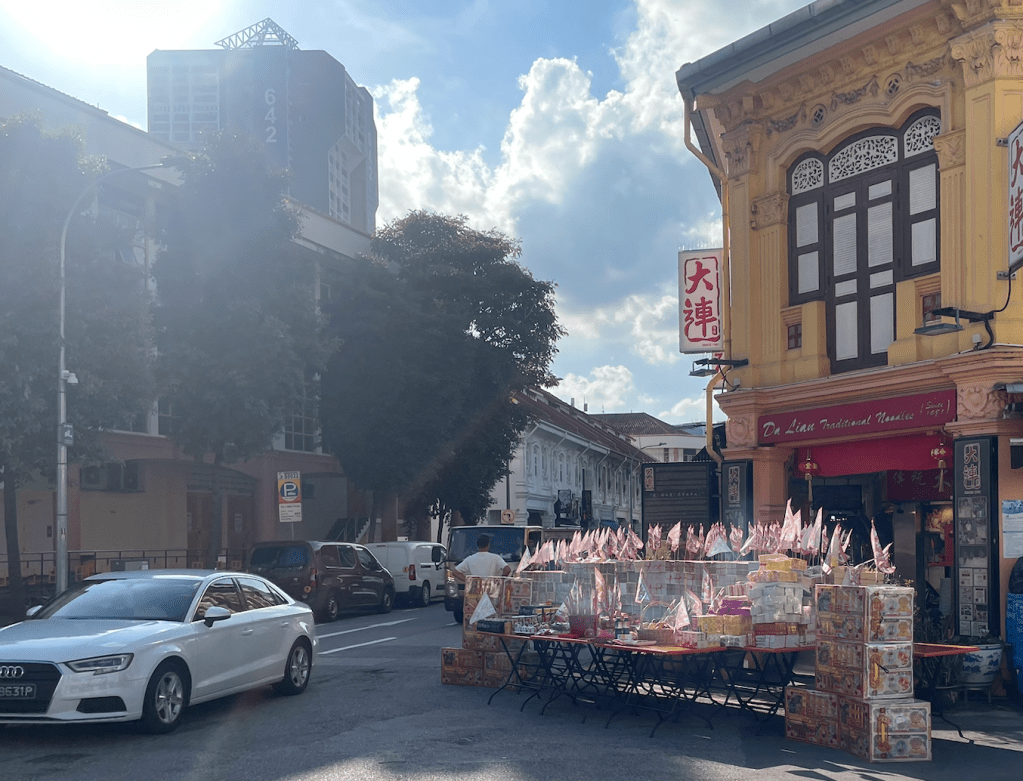
Photograph: The seventh month of the Chinese calendar has just passed, which meant that for a few nights Singapore’s streets were blanketed in the smoke of burnt roadside offerings. I stumbled into a few major celebrations, at Jalan Berseh and the Sim Lim Tower. This was on Syed Alwi Road.
 Enfolded Histories
Leave a comment