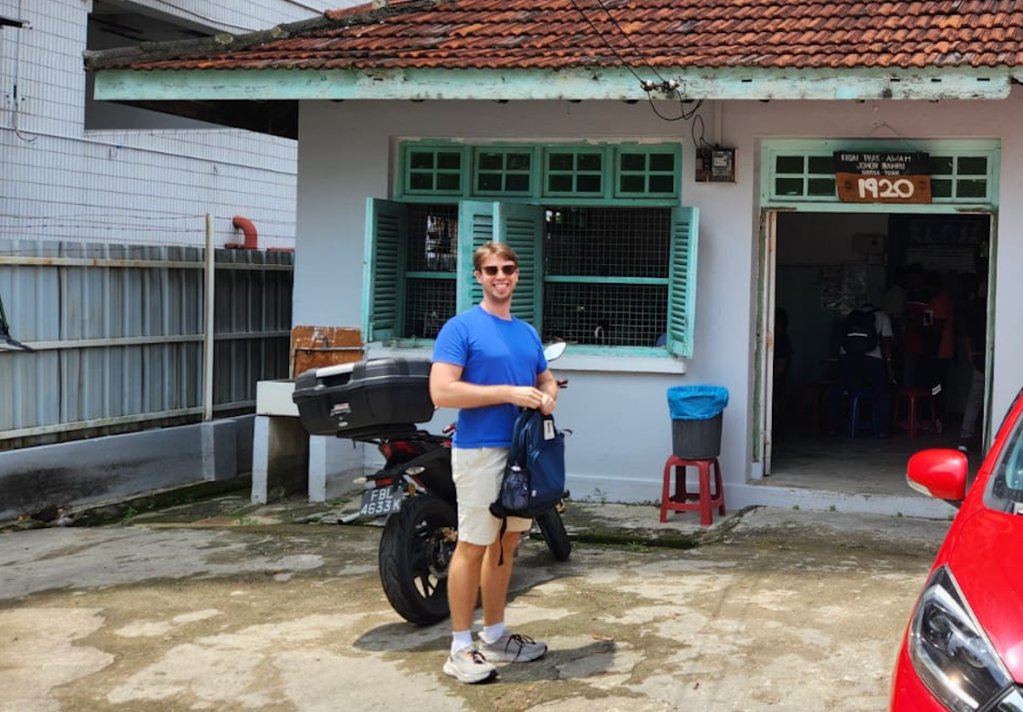
Enfolded Histories

Thinking about animals, viruses, movements, cities, ecologies, infrastructures, and more

  • I have never much enjoyed writing conference speeches and making PowerPoints — which I am doing now, finalising them in a hotel in Takamatsu, Shikoku, Japan. For some academics, the joy in their work comes from a certain sense of solidity — knowing as much as can be known about a topic, and laying out your arguments elegantly and proofed against attacks. I know that feeling and like it too. But, for me, every body of knowledge you build is always an invitation onward and outward: there is always something new to dig at or a novel provocation to make. A conference speech is an inventory of what you know and think. But harvesting is much more fun than saying how full the barn is.

    I am, however, excited to be at the Asian Association for Environmental History conference in Takamatsu, where I arrived yesterday, taking the train across the Seto Inland Sea from Okayama. And, in fact, it serves as a great opportunity for me to take stock of my “Emergency Ecology” article, which I have presented twice already: once at SUTD and once at HKU, both in April, and which I am due to present at SMU in October before sending it off to a journal. Professor Jaehwan Hyun of Pusan National University invited me to join the panel “The Trans-Asian History of the Migratory Animal Pathological Survey” after we met and found the commonalities in our work in June 2024 in Seoul. Our discussant is Professor Annika Culver and I am presenting along with Richmond Wu. Across the four of us, we shall be discussing the MAPS Project which ran 1963 to 1973 from Korean, Japanese, Taiwanese, and Malayan/Malaysian perspectives.

    Back during my PhD, I was advised that a good presentation — which rarely extends beyond twenty minutes — is best when it says three things. Simple arguments are made in the presentation, then more complexity is revealed in the Q&A. So here are the three arguments for this presentation:

    • Colonial Malaya was a key site in the development of disease ecology. This is a broader project of mine, which I’ve noted before on this blog. It was so as, for half a century, plantation management drove elucidation (via funding and the provision of research sites) of the ecological links between landscape, people, animals, and disease, whilst the extent of environmental transformation and the range of biotopes this led to drove attention to edge effects and landscape epidemiology. Above all, this characterised the post-1947 attention to scrub typhus, which I wrote about in “‘Back to the Jungle”‘ (2023). Not just a vaguely Hippocratic attention to the “airs, waters, places” of disease transmission, under Jack Ralph Audy (in Malaya 1947 to 1959) this was a sophisticated and thorough ecological theory of landscape epidemiology, comparable I think only to the parallel efforts of Evgeny Pavlovsky in Soviet Russia. This meant that, in the late 1940s and 1950s, there was a tradition of principally British medical-ecological research, centred at the Institute for Medical Research (f. 1900/1901), and an active programme of researching rickettsioses, viruses, and bacterial infections.
    • Decolonisation and the Cold War drove a new strategy of zonation amongst expatriate researchers in Malaya. Malaya became independent in 1957. Singapore became internally self-governing in 1959, then independent as part of Malaysia in 1963 and as a republic in 1965. This meant that expatriate colonial scientists were replaced by local staff in a programme of Malayanization. Most left by the early 1960s. Before they did so, they had to scramble for new strategies of funding and intellectual prestige, as the Colonial Office no longer looked likely to fund research. Southeast Asian decolonization occurred amidst the Cold War and the expansion of American military and political power across Asia. Therefore American research funds and strategic interests formed the natural new locus of money, power, and prestige. This drove researchers in Malaya to tailor research interests to projects of interest to the US military and the Rockefeller Foundation: especially viruses of northeast Asia, including Siberia and Japan. This meant that in Malaya such viruses as Japanese encephalitis, Russian Spring-Summer Encephalitis, Langat Virus, and Lanjar Virus came to the fore. Despite their low profile in Malaya itself, investigating these viruses drew American attention and money. Materials I found at the Rockefeller Archives Center this March made this explicit in quite funny ways. This re-figured the geographical imagination of these researchers: Malaya now was one part of a chain of sites leading from Australasia through to Siberia, linked by possible virological and rickettsial transmissions. Researchers looked at the Malayan landscape as the possible key to unlock questions of Siberian significance.
    • This Malayan context shaped the MAPS project. Annika Culver’s Japan’s Empire of Birds (2023) is excellent on the Anglo-American-Japanese background to the MAPS project. This article shows too however that there was this crucial Malayan background to the Project. Not least, the half-century tradition of ecological research in Malaya enabled Elliott McClure to spend time in Malaya between 1956 and 1963 where he elucidated early ideas on avian migration. So too Audy’s theories regarding the “seeding” of landscapes with zoonotic disease shaped the Project — including in the concluding report of the Project published in Bangkok in 1973.

    Those are the three key points of the paper then. Stating them I am itching to hunt down the stray leads. What to make of the parallelism between landscape epidemiology as it developed under Audy in Malaya and Pavlovsky in Siberia — especially as, from I think the 1960s, these researchers themselves began to make links and collaborate? What to make of Charles Edward Gordon Smith’s career, from Malaya to the bacteriological laboratory at Porton Down? What about George Anastos’s work on the ticks of both Malaya and the Soviet Union? But for now, this Takamatsu conference has been valuable in forcing me to lay down an inventory of the paper. Its strengths are clear to me. Years of research allow me to situate the 1960s project in developments leading back to the turn of the century. An attentiveness to geographical surprise means I’m almost unique in linking together Malaysian and Siberian histories. There is a neat explanation for the epidemiological significance of birds in the changing sociopolitical circumstances of researchers in Malaya: placing a history of science into the personal life-stories of desperate and depressed scientists. Its weaknesses are that I have yet to thoroughly flesh out the Malayan influence on the MAPS project more broadly, situate MAPS within the broader history of avian zoonosis, and to properly place it in its pan-Asian framework — which is where this panel shall help.

    Reading: Walker’s 2015 history of Japan, semi-recreationally whilst travelling here — though it is good on histories of environment and disease.
  • There is a whole publishing sub-industry now of books for academics on how to write academic books. I’m using William Germano’s From Dissertation to Book (2013) for my own monograph, which I am revising ahead of a deadline of February 2026. These books turn the formidable task of writing a monograph into a neat sequence of processes: reading, annotating, rewriting, and selling, deliverable by due dates and with an emphasis on crisp and clear sentences, the sense of an audience, and signposting where the book is going and what it does.

    I am not grumbling. These books are invaluable guides: to make a sausage, you need to know how to grind the mince and slip it in the casing. And reading books like these helped make me write like an American. My sentences now are shorter and pointier. They undulated at Cambridge and when I first started at HKU. But now I know a good sentence is quick, crisp, and surprising. I was sad to let go of the semi-colon — or, even better, the viz.-headed subclause! — but writing like Lawrence Sterne does not win you much in academia today.

    Though there is a danger with these books as well. Too tight a schedule, too Fordist an allocation of tasks while rewriting poses its own danger. There are two ways how writing draws from beyond the expressible. First is that good ideas have mysterious origins. Cormac McCarthy’s “The Kekulé Problem” (2017) is excellent on this. In thinking, talking, mathematics, “there is a process here to which we have no access. It is a mystery opaque to total blackness.” The best thoughts bubble up from the unconscious — expression beyond language, mathematics beyond numbers. They are ineluctably mysterious and resistant to timetables. The second is that good writing requires a more synaesthetic sense than it does an aesthetic one. Sound ideas and precise expression have a certain taste to them. Writing well means learning what tastes good. Ideas and words can be crunchy or chewy, fresh or with an aftertaste. It is paradoxical but the best writing comes from a place beyond language. To write a book, therefore, means balancing: a careful and logical architecture, laid step-by-step, but with a wellshaft down to an unconscious in which ideas appear according to a rhythm entirely their own.

    I have just re-read and annotated the whole of my manuscript. Germano recommends the pruning shears and I am cutting much. First to go obviously are the structural guideposts of a thesis. “This section does x and y” and so on — needed in a thesis, dull in a book. The original thesis was about insects but also molluscs and rodents: now I’m keeping the bugs and snails but slashing out the rats. I spent years writing about bubonic plague and rats, principally in Hong Kong: resulting in this 2020 Somatosphere piece, which I presented to Eben Kirksey’s and Rachel Vaughn’s Multispecies Coronavirus Reading Group in 2021. An essay I wrote on this was runner-up for the Roy Porter prize in 2018. So I have some sadness removing this material from the manuscript. But cut from the book, it is time to finally realise the promise of that work in publishing my article, “The Rat, the Cow, and the Cockroach: Hong Kong and the Vanishing Animals of Plague Research.” And then I shall be done with it. Otherwise I am cutting much of the theoretical structure: entanglement excited me in 2020. In many ways it still does. But I am developing instead a theoretical structure of enfolding and a spatial vision less of entanglement than topology, laid out in the introduction rather than recapitulated at the beginning of each chapter. More to come as I think this through.

    What excites me above all is the conclusion. In the thesis it is exciting but muddied. Conclusions that recapitulate are boring and I have tried in both ‘”Back to the Jungle”‘ (2024) and in a forthcoming Journal of Asian Studies article on oil-and-water in Hong Kong (2026, probably) to first round up the arguments and then spin them out, as lines-of-flight opening questions beyond the article’s parameters. The conclusion is anchored in the image of a snail shell: found in piles at Government House when the British returned to Hong Kong in August 1945. The shell anchors an expansion outward in scale: the micro-scale of the shell itself, constituted from the lime of the House’s walls, as a way into micro-ecologies of pests, houses, bodies; the macro-scale of the snail, journeying across infrastructures of the British Empire, to Hong Kong, Singapore, and beyond; and then then the planetary scale, of the snail as indexing “Anthropocene” transformations. It requires some work to really shine however and this is now the task for October.

    Reading: About Muthuvelu Nadchatram, Malaysian entomologist who served as laboratory assistant to Jack Ralph Audy and then the leading acarologist of post-Merdeka Malaysia. Nadchatram’s article, “The Beneficial Rain Forest Ecosystem, with Environmental Effects on Zoonoses” is excellent. Probably the most thorough and up-to-date expression of the Audy model of landscape epidemiology, laden with warning of the emergent possibilities of Malaysia’s Ixodid ticks. Discussions of “Planetary Health”, “One Health,” “EcoHealth” — especially in Singapore — are to my mind missing this local tradition of sophisticated disease ecology existing right under their nose. I would be very much interested in talking with those who knew Muthuvelu Nadchatram, if they should stumble across this site.

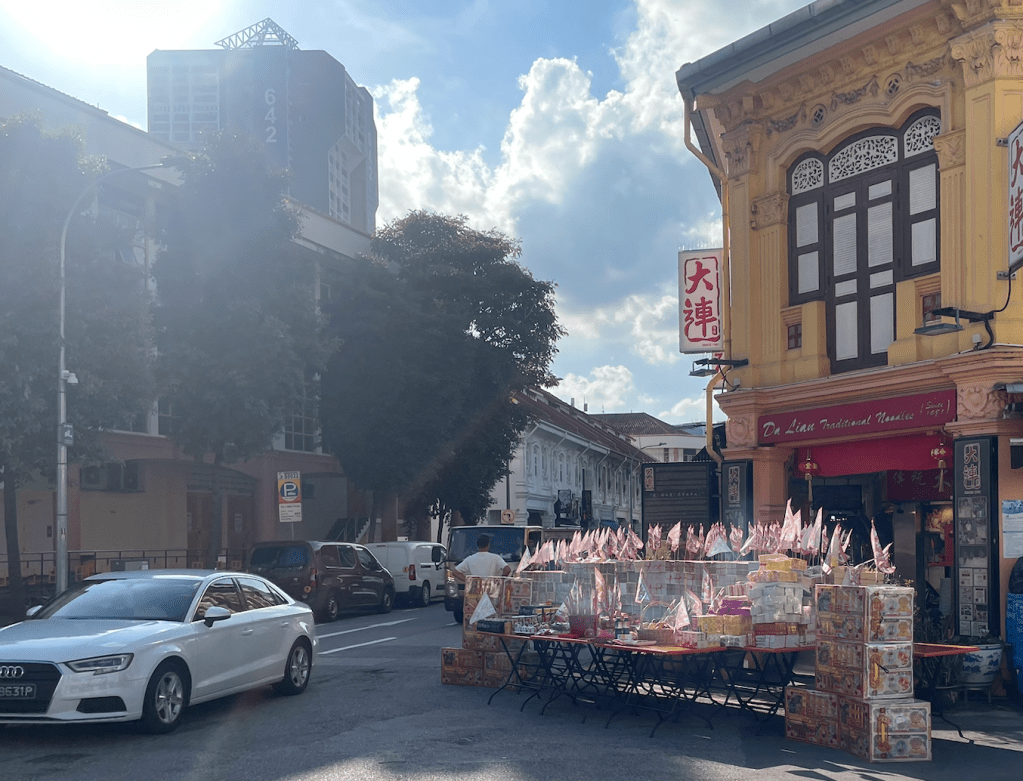
    Photograph: The seventh month of the Chinese calendar has just passed, which meant that for a few nights Singapore’s streets were blanketed in the smoke of burnt roadside offerings. I stumbled into a few major celebrations, at Jalan Berseh and the Sim Lim Tower. This was on Syed Alwi Road.

  • Virginia Woolf in A Room of One’s Own (1929) has a superb phrase for a certain kind of joy: “the lamp in the spine.” This is in the context of eating: “One cannot think well,” Woolf writes, “love well, sleep well, if one has not dined well. The lamp in the spine does not light on beef and prunes.” But for me the phrase has long held power as describing the pleasure of intellectual work. When it comes, this feeling is suffused with a strange kind of almost physical pleasure, difficult to vocalise actually — which makes Woolf’s phrase, both figurative and bodily, enigmatic but exactly evocative, so appropriate. Finding new things, threading new connections: the lamp in the spine lights up.

    The lamp is lit again. I am in new surroundings with new trajectories of research — and have been so excited to begin. After the three years of postdoctoral work at Nanyang Technological University, in July I moved to an assistant professorship in urban history at the College of Integrative Studies (CIS), Singapore Management University (SMU). Out from Jurong, sat snug now at the foot of Fort Canning Hill. I have a room of my own and space and time now to work. Three major things keep me busy.

    Pests Book: I am revising Liberating Parasites: Pests in British Malaya for publication, aiming to submit the dossier in February 2026 and now going through it line-by-line, cut-by-cut. This manuscript was written in maddening circumstances: in Hong Kong, 2019-2021, being battered round the head first by protests then covid. The manuscript tastes of it: late nights, the eight coffees a day, the frenzy of finishing gives the prose a certain mad tang. But for all the messiness, it has been enormously exciting to return to it. Its arguments are strong, I think:

    • that the elasticity and generativity of the concept of “the pest” provided opportunities for all kinds of different actors (colonial legislators, chemical companies, entomologists, etc.), who thereby preserved this vague category even at a time of increasing scientific specialisation

    • that colonial economic and infrastructural transformation in Malaya provided a glut of opportunities for certain insects to flourish and spread, even as broader ecosystems were wrecked, and that these shifts served to frame/interpellate these insects as “pests” (as I argued in my 2022 Roadsides piece: new roads meant lalang grass meant locusts, the insects repurposing an infrastructure of extraction; the spatiality of the road making the locust come to notice)

    • that there was great multiplicity in colonial responses to insects/pests. An exterminatory degradation of the pest was paralleled by fascination and disquiet — especially that insect pests indexed disordered worlds, the colonial disruption of the landscape become manifest. What I am able to do much better now than I could in 2021 is to write this section within the broader longue durée of Malayan/Malaysian ecology. Figures such as Jack Ralph Audy, whom I wrote about in Medical Anthropology in 2023 bridge the emerging ecology of interwar Malaya, which I shall write about in the book, with the explicit ecological concerns of the postwar world.

    The task now is to make these arguments clearly. Adorno is the great model of argument-making, combining a sensitivity to paradox with economy of expression. “The thicket is no sacred grove,” as he writes in Minima Moralia (1951). “Precisely the writer most unwilling to make concessions to drab common sense must guard against draping ideas… in the appurtenances of style.” Rephrasing, bulking, extending, polishing, contextualising — and actually quite good fun.

    Otherwise work continues on two new projects.

    The first situates the history of the Migratory Animal Pathological Survey (MAPS) in its Malayan context. I want to argue that postwar Malayan ecology was instrumental shaping the contours of this project and therefore the broader history of avian zoonosis. Warwick Anderson gave me a push to work on this at the HOMSEA conference in 2023 and I’ve been needling at it since. I presented a paper on it for the first time at the Singapore University of Technology and Design (SUTD) in April 2025 and again at Hong Kong University (HKU) that same month and shall present on it again at the Asian Association for Environmental History conference in Takamatsu this month, with my draft paper to be submitted in October 2025. From Malaya, this project looks northward — up to Japan and far eastern Russia, with the provocation of being the first person to write on the “Siberian history of the Malaysian rainforest”. More to come.

    The second project focuses on the history of the Coconut Rhinoceros Beetle (Oryctes rhinoceros) and the network of biological control efforts spanning both Southeast Asia and the South Pacific which developed between the 1910s and the 1970s. From Malaya, this project looks eastward — connecting Singapore to Tokelau. I am currently drawing together a grant application for a research assistant, a trip to Nouméa, New Caledonia, and a conference on histories of biological pest control to be held at SMU in 2026/2027. More to come too.

    Other ideas wash about in my mind. Infrastructural bacteriology. Villain-hitting under flyways in Hong Kong. Coprolites and WWI munitions. Rainforest canopies and boardwalks. One model for writing history: Pynchon’s Gravity’s Rainbow.

    Reading: As during this summer, lots of Marshall Sahlins; Paul Theroux’s abysmal Saint Jack (1973), a Singapore novel which would be exotic but is actually dreary.

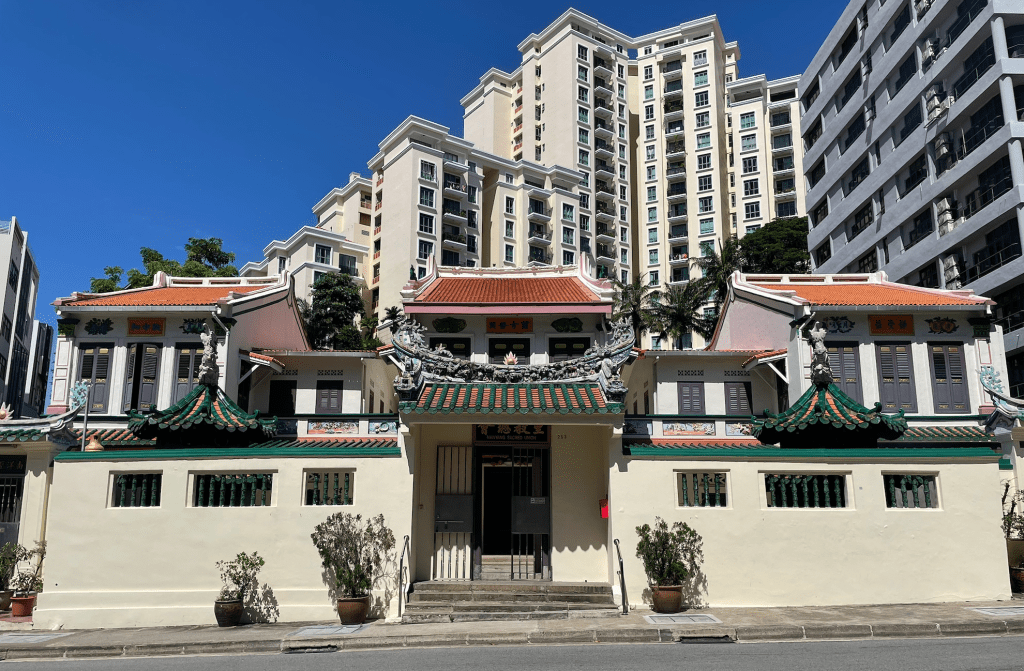
    Photograph: the mysterious Nanyang Sacred Union, on Tank Road, on the far side of Fort Canning Hill from SMU, Singapore. After three years, still being surprised by the Singapore streetscape.